Today is the last day of our trip to Brazil. All the packing is finished (though we still can’t quite figure out why we brought all that stuff) and our apartment has been cleaned. We’re taking the last day for appreciation, maybe some coffee and a walk on the beach, and for reflection.
I recall that I have always wanted to “travel”, as long as I can remember. Thankfully, no one ever really asked me why, because I would only have been able to supply the lame, “Well, new people...new places,” answer. But now, after a very long, and somehow at the same time a very short nine months, I know the answer to that question.
I wanted to travel because I wanted to know myself. And I don’t mean that in a spiritual, esoteric way, and not in a confused, fumbling towards adulthood way. It is only that so many times, who we think we are as people is really a product of our environment, our job, friends, family, even our city. Travel allows you to break free from that, to put yourself in a radically different place. Some aspects of yourself change and some stay the same and what you’re left with, well...I would like to think that it’s one stop closer to your true self. Some things about myself have not changed: I still am a picky eater and I get cranky when awoken from naps. But some things have certainly changed alot...
I’m not nearly as scared about the world as I would like to be. Much of my life has been spent in a haze of paranoia, always imagining where the next kidnapping attempt or natural disaster would come from. I think Brazil just overloaded my system: you cannot possibly be scared of everything there is here to be scared of, so why bother trying? I’m still very safety conscious, and I do still envision kidnapping scenarios in my free time, but most of life just doesn’t terrify me anymore.
I have not an ounce of vanity. I always suspected this was the case, but it turns out to be true. If I’m not going to be inspired to fashion by the stylish Brazilians, then absolutely nothing is going to get me out of my comfy T-shirts. Makeup, hair, plastic surgery, who cares? I think, at heart, I just really don’t care about appearances. Here’s hoping this changes (at least a little bit) back in the States.
I love being American. I’ve never really had a national identity before, but being away from my country has really given me a new perspective on the importance of my own nationality. Despite whether or not my country is currently making me proud or ashamed, I always say I’m American with a smile on my face and simply try to be the best representative of my country that I can be.
I’m a lot friendlier then I suspected. I know, it’s a surprise to me too. I think previous anti-social tendencies of mine really stemmed from a lack of basic ideas about community. But when you are far from home, you’ll grasp at any community that presents itself and I’m so thankful for all the warm-hearted and generous American that I’ve been able to meet while in Rio. Additionally, if one can’t learn to embrace the idea of community from the always-noisy, always-touching, always-present Brazilians, then one is truly hopeless.
I know now that life is unpredictable. This may seem trite, but honestly life has been pretty much predictable up to this point. Now, though, we are unexpectedly coming back to Brazil for another six months, and though I am incredibly excited, I also feel as if I have reached the place where the sidewalk ends and I know not what awaits me on the other side. But, I feel confident that I can face it with the help of friends and family, in a pair of comfy sneakers, and, though with a great deal of nervousness, without any fear.
Thanks again to everyone who has read our blog and provided feedback! We look forward to taking this up again when we return to Brazil in September!
2010-08-02

60 Things You Never Knew About Brazil (And Probably Never Wanted To)
It is a traditional for Brazilians to wear white on New Year’s Day Brazil leads to world in plastic surgery Brazilians refuse to wash their underwear in the laundry machine; it is considered unsanitaryInstead, underwear in Brazil is washed by hand, in the sink or the shower, with special underwear soap McDonald’s can be ordered online and delivered to your home There are several ad campaigns in Brazil encouraging people to pee in the shower According to Brazilians, peeing in the shower saves the rain forest It is a common conspiracy in Brazil that America has purchased the Amazon in secret and plans to annex it to the United States Brazil is approximately the same size as the continental United States All bills – electricity, internet, rent – can only be paid by a direct deposit into a specific bank account One cent coins exist here, but I’ve never seen one in 9 months All prices here are always rounded to the nearest 5 cents for convenience There are currently two different sets of currency in existence Sour cream does not exist here – anywhere The best onion rings in the world can be found in Sao Paulo, Brazil at a restaurant called “The Fifties” (yes, in English) There are more state holidays in Brazil than any other country on earth Those holidays are in addition to the 30 day mandatory vacation that every employee in Brazil receives They do celebrate Valentine’s Day here, along with the Day of the Lovers, Day of the Woman, Day of the Man, and Day of the Friends It is possible to consume shrimp, watermelon, ice cream, fried cheese and beer all while sitting on the sand in your bikini (but not advisable) Most kiosks along the beach in Rio are open 24 hours a day Megan’s favorite Brazilian institution is the “chaveiros”: stand-alone, 24-hour key huts on the sidewalk for all your copying needs Matt’s favorite Brazilian institution is the popcorn salesman who sets sup shop outside the movie theater to undercut the prices inside For Easter, instead of baskets, it is traditional to give children (and adults) large, plastic eggs that are filled with toys and candy Brazil is the best, and friendliest, place to be lost in the world Brazil is the worst, and unfriendliest, place to get anything accomplished in the world Personal dryers for clothes in the home do not exist here, but washers are very popular It is possible to tell if a city’s soccer team is winning or not simply by opening the window and listening for the cheers or the cursing Dogs in Brazil play with coconuts the way dogs in the US play with balls Frozen yogurt is a very recent and incredibly popular phenomenon here, very similar to Starbucks in the United States There are two Starbucks in Rio de Janeiro, and they have cinnamon rolls Brazilian wine is atrociously scary; thank god they know how to make a good caipirinha Most Brazilians do not have a front door key; doormen are the only ones who can let people in or out of the building It is important in Brazil to remain on good terms with your doorman There is a sign in every elevator in Rio that says “STOP: check and make sure the elevator has actually halted on the right floor before you step down the elevator shaft” Rio de Janeiro operates under a no tolerance law for drinking and driving; you are not allowed to drive if you have consumed absolutely any alcohol Taxis here proudly display bumpers stickers advertising the no tolerance law Taxi drivers here are really great sports, overall Many taxis nowadays have mini televisions hooked up in their cars; they are always set to Brazilian soap operas Brazilian soap operas, or “telenovellas” are incredibly popular here with all genders and age groups Arabic food is one of the best ethnic foods in Rio de Janeiro Megan’s favorite word in Portuguese is “parallelippiddo” which means cobblestone The term for giving birth here is “dar de luz” or literally giving the light Brazilians have adopted many English words into their own vocabulary, like “voucher” “status” take-out” ”delivery” and “sale” The worst English translation that we’ve ever seen in Brazil was “Melissa Love Pirate” which was proudly emblazoned as the name of a popular shoe store Construction is so popular in Brazil that it is impossible to live anywhere without omnipresent sound of banging hammers Most heavy construction is performed by men in a pair of swim trunks and a size-too-small pair of flip-flops All utilities, including light and internet, are run underneath the city via manholes You must never, never, never turn the air conditioning and the microwave in your apartment at the same time Brazilians think that vegetarianism means that you eat no beef, but chicken and fish and pork are still fine There is no pasteurized milk here Rental prices in Rio de Janeiro have risen 76% in the last year because of the upcoming Olympics and World Cup Most Brazilians have a hammock in their apartment Illegal vans that fit 8-10 people follow along popular bus routes and pick up people, for a price, that have been left behind On most side walk corners, illegal lotteries are run by innocuous looking old men sitting at a desk all day Ping-pong (pronounced pingee-pongee) is very popular in Brazil Not content with mere Frisbee, Brazilians have invented a multitude of their own beach games involving frescobol (like paddle ball) and futevolei (volleyball played with no hands) There is an American style football league that is run every weekend on Copacabana beach Brazil has the highest rate of publishing houses to literate people in the world The most commonly used word in the Portuguese language is “opa”, which translates into “whoops!” Brazilians shower more often than any other nationality; an average of about 3 times a day If you ask any Brazilian where in the world they would most like to visit, they will respond with Disney World
2010-08-01
Brasilia

Recently, I had the opportunity to travel to Brasilia, the capital city of Brazil to attend a conference. Despite being the seat of government and possessing some of the best examples of modernist architecture in the world, the city is seldom visited due to its incredibly remote location. Pictured to the left is the presidential palace. Under the direction of President Juscelino Kubitschek, Brasilia was constructed out of nothing in just four years. The location was so remote that there was not a paved road within 200 kilometers of the site when work began. The city is also known for having perhaps the most rigid zoning laws in the world, with the initial city plan dictating the most minute details down to the presence of lamp posts and newsstands.


Pictured to the left are the congressional offices, with the Senate Chambers in the domed building and the House in the bowl. The two towers between serve as the offices of the congresspeople. To the left is the view from inside the Metropolitan Cathedral. Each of these buildings were designed by Oscar Neimeyer, who was given nearly full control over the architecture of the city.
2010-02-18
Serra do Cipo
The Serra do Cipo (SAY-ha do see-PO) is in the middle of nowhere. Really. Look it up on Google Maps - there is not a road or city or anything within miles. Just lots of mountains, waterfalls, wild horses, overgrown "hiking" trails, and one ex-military Brazilian with a rather large machete who used to live in Boca Raton but now makes his living as a park ranger named Tony.
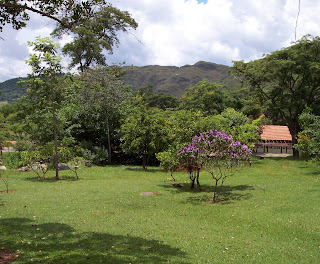
We stayed at a small pousada that was nestled in the foothill of the mountains. The picture above was the view out our window. It was pretty rustic - goats and all manner of poultry had free run of the place - but still beautiful and very quiet.
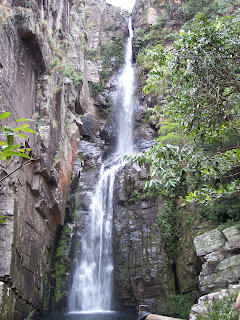
This waterfall was called the Veu da Noiva, or the Bride's Veil. It's actually located in a YMCA campground, and is popular with swimmers and cliff divers. No, I didn't go in, but Matt was brave enough and he had a great time.
Click here to see all our pics
2010-02-15
Live Blogging from Carnaval
So, despite that fact that Matt and I are holed up in Belo Horizonte during Carnaval, as far away from the craziness of Rio as we could get, we were still really excited being in Brazil during this time. No, we weren't planning on going out and doing anything crazy, we're still total nerds. But we were really excited about getting to watch the parades on TV.
If you've never seen footage of the Carnaval parades in Rio before, I suggest you check out the clip below immediately. It honestly makes the Macy Day's Parade look like it was produced by a 2nd grader. Here's how it works: There are 12 samba schools in the main parade, each with between 3600-4100 people in them. They have 82 minutes to traverse the 1/4 mile length of the Sambadome, during which all of those 4000 people dance and sing while carrying what looks like 50 extra pounds in costume weight. Every school has a theme which their costumes and floats revolve around loosely. First comes the commisao da frente, which are a small group of dancers who have a very precise, choreographed dance they perform. Then the flag carriers, a man and a woman, and trust me you haven't seen a hoop skirt like the one she's got on since Gone with the Wind. Eventually, the bateria appears, which is the huge collection of percussionists that keep the beat for the entire parade.
I wondered why Carnaval is never really broadcast on television in the United States. And trust me it's not because of lewdness, because I've seen worse on cable. I think it might have something to with the enormous liberty that these schools take with history, nations, and people. For instance, the following is a list of all the characters that I saw samba last night: Wizards, Dick Tracy, Pancho Villa, Aliens, Jack Sparrow, Buddha, Batman, Moses, Flappers, Pharoahs, Michael Jackson, Marines (I think my favorite), Druids, Conquistadors, and the Flames of the Inquisition (I kid you not). They seem to be equal opportunity offenders at least.
Still, I don't think I've ever seen that many happy people, even at Disney World.
Sometimes, while in Latin America, you often find yourself critquing the organization, bureaucracy, and just the general togetherness of the people here. But no more. Perhaps they don't believe in informational dissemination quite the way we do, but one thing's for sure: they can sure as hell put on a parade.
If you've never seen footage of the Carnaval parades in Rio before, I suggest you check out the clip below immediately. It honestly makes the Macy Day's Parade look like it was produced by a 2nd grader. Here's how it works: There are 12 samba schools in the main parade, each with between 3600-4100 people in them. They have 82 minutes to traverse the 1/4 mile length of the Sambadome, during which all of those 4000 people dance and sing while carrying what looks like 50 extra pounds in costume weight. Every school has a theme which their costumes and floats revolve around loosely. First comes the commisao da frente, which are a small group of dancers who have a very precise, choreographed dance they perform. Then the flag carriers, a man and a woman, and trust me you haven't seen a hoop skirt like the one she's got on since Gone with the Wind. Eventually, the bateria appears, which is the huge collection of percussionists that keep the beat for the entire parade.
I wondered why Carnaval is never really broadcast on television in the United States. And trust me it's not because of lewdness, because I've seen worse on cable. I think it might have something to with the enormous liberty that these schools take with history, nations, and people. For instance, the following is a list of all the characters that I saw samba last night: Wizards, Dick Tracy, Pancho Villa, Aliens, Jack Sparrow, Buddha, Batman, Moses, Flappers, Pharoahs, Michael Jackson, Marines (I think my favorite), Druids, Conquistadors, and the Flames of the Inquisition (I kid you not). They seem to be equal opportunity offenders at least.
Still, I don't think I've ever seen that many happy people, even at Disney World.
Sometimes, while in Latin America, you often find yourself critquing the organization, bureaucracy, and just the general togetherness of the people here. But no more. Perhaps they don't believe in informational dissemination quite the way we do, but one thing's for sure: they can sure as hell put on a parade.
2010-02-11
Congonhas

About an hour outside of BH, in the middle of an otherwise ugly, industrial town lies the magnum opus of one of Brazil’s most famous artists, Aleijadinho. The artist, whose name literally translates to “little cripple,” suffered from leprosy and eventually had his hands and feet amputated. While the traditional biography of Aleijadinho has been recently disputed, it is believed that the sculptures of the 12 prophets surrounding the church were carved by Aleijadinho after having lost the use of his hands. True or not, the story of Aleijadinho and his sculptures at the Church of Bom Jesus de Matozinhos remains inspirational for many mineiros and is the most important site for Christian pilgrimage in Brazil.
Inhotim
 About a two hour bus ride outside of Belo Horizonte, across the mountains, past an industrial wasteland, and through too many tiny villages to count lies a jewel of the modern art world: Inhotim. Imagine a place landscaped within an inch of its life, dotted with seating straight out of a Crate and Barrel catalogue, and then scattered with oversized art installations. Like all wonderful things in the world, it is the result of more money than someone knew what to do with. And even though you constantly have the painfully guilty feeling that this wealth could have been better spent alleviating other, more pressing problems in Brazil, it is still truly an amazing place to behold.
My favorite ‘work’ was called the Sonic Pavillion (pictured above) by an American artist. This was a large, circular building that crouched upon a hill overlooking a beautiful landscape below. Microphones had been dropped 200 meters into the earth, and then the vague sounds of the shifting earth were broadcast into the building. The glass walls were glazed so that the viewer could only see directly in front of themselves, unless they were standing in the center of the room; then they could see the full 360 degrees. It was an amazing experience: You are rooted to the earth, inescapably so, but your vision of the path ahead is clear and far, though hampered by tunnel vision. Unless you center yourself, and then...then everything becomes possible.
Click here to see all our pics from Inhotim.
2010-02-07
Pampulha
 Pampulha is a ritzy suburb of Belo Horizonte about 20 minutes outside the city center. Normally planned developments aren't really our thing, but this particular one was built by one of Brazil's foremost architects, Oscar Niemayer, in collaboration with one of Brazil's most well-known visionaries, Juscelino Kubitschek (yes, that's a Brazilian name). The result was a man-made lake with a 12 mile circumference dotted by little gems of modernist architecture. The building to the left is actually a church, believe it or not, and one of the most distinctive buildings in Brazil. Visiting it was actually a little shocking, even for the non-religious. Realizing that it was built almost 60 years ago makes it impressive. All in all, it was a nice break from the overly ornate churches of baroque Portugal and colonial Brazil.
Another Niemeyer building on the lake was the Casa do Baile. Now used as an architectual museum of Belo Horizonte, it was originally created to host dances and parties. Overall, Pampulha provided a refreshing, if strange, contrast to the omnipresent skyscrapers of Brazil and serves to remind you that this country can be about so much more then beaches and soccer.
2010-01-17
Ouro Preto
Yesterday we decided to take a trip outside the city of Belo Horizonte to the village of Ouro Preto, a small colonial mining town from the 17th century nestled in the mountains. Once the epicenter of the gold and diamond boom in Brazil, it now plays host to tourists attracted by its many churches and gorgeous vistas.
 Not only does it have breathtaking views, but somehow the town has managed to achieve that perfect state of charming ruin. The churches are crumbling and mildewed, grass grows out of every crevice, and the interiors are thick with dust and shadows, and yet somehow they are the better for it.
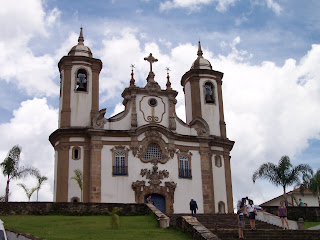
Not only does it have breathtaking views, but somehow the town has managed to achieve that perfect state of charming ruin. The churches are crumbling and mildewed, grass grows out of every crevice, and the interiors are thick with dust and shadows, and yet somehow they are the better for it.My favorite part was the old opera house. It has the distincion of being the oldest running opera house in the Americas, still in use today after its creation in 1740. Click here to see the rest of our pics.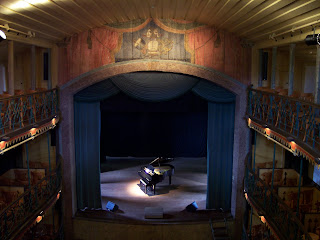
2010-01-05
The Top 10 Reasons to Travel with a Historian
10) It could be worse: they could be an –ologist. You know, anthropologist, biologist, etc.
9) Historians sometimes answer the question “And how was your day honey?” with a “Oh, pretty normal, just reading some letters written by a king from the 17th century.”
8) They get to go on awesome trips like this one.
7) It’s really funny when they don’t know some really simple historical fact, and it can be used to embarrass them for years.
6) Even though historians lie and say that they know more languages than they really do, they still know more than the average person, and it can be pretty useful.
5) They all like to drink...a lot.
4) What other profession can be symbolized by pocket protectors and elbow patches?
3) Usually historians can actually answer those pesky, rhetorical questions that you ask yourself in a new place, like “When was this city founded?” and “Why do they like to eat that funky stuff?”*
2) Watching their attempts at assimilation can be pretty amusing. One word: Speedo.
1) Historians are important!
Okay, once you’re done laughing, keep reading.
Let me explain. To plagiarize heavily from a common economics lecture, take a Taco Bell meal. No one person on the earth knows everything there is to know about how to make that meal. No one knows at what time the tomatoes ripen best, at what temperature to cook the tortilla shells, and the marketing ploys behind the color of the wrapper. It takes a lot of different people.
History is like that. The next time you say to someone, “Yeah Brazil, don’t they speak Portuguese?” you should go out and hug a historian. Because hundreds of people have worked for centuries on thousands of different issues so that the very big and complex issue of world history can filter down into a textbook and then into our little pea brains. Just like a meal from Taco Bell, except not quite as tasty and much more educational.
So go on, hug your nearest historian. Oh, not too closely...remember that pocket protector...
9) Historians sometimes answer the question “And how was your day honey?” with a “Oh, pretty normal, just reading some letters written by a king from the 17th century.”
8) They get to go on awesome trips like this one.
7) It’s really funny when they don’t know some really simple historical fact, and it can be used to embarrass them for years.
6) Even though historians lie and say that they know more languages than they really do, they still know more than the average person, and it can be pretty useful.
5) They all like to drink...a lot.
4) What other profession can be symbolized by pocket protectors and elbow patches?
3) Usually historians can actually answer those pesky, rhetorical questions that you ask yourself in a new place, like “When was this city founded?” and “Why do they like to eat that funky stuff?”*
2) Watching their attempts at assimilation can be pretty amusing. One word: Speedo.
1) Historians are important!
Okay, once you’re done laughing, keep reading.
Let me explain. To plagiarize heavily from a common economics lecture, take a Taco Bell meal. No one person on the earth knows everything there is to know about how to make that meal. No one knows at what time the tomatoes ripen best, at what temperature to cook the tortilla shells, and the marketing ploys behind the color of the wrapper. It takes a lot of different people.
History is like that. The next time you say to someone, “Yeah Brazil, don’t they speak Portuguese?” you should go out and hug a historian. Because hundreds of people have worked for centuries on thousands of different issues so that the very big and complex issue of world history can filter down into a textbook and then into our little pea brains. Just like a meal from Taco Bell, except not quite as tasty and much more educational.
So go on, hug your nearest historian. Oh, not too closely...remember that pocket protector...
2010-01-02
Monkeys, Quatis, and Mountains, Oh My!
Today we went out to the Parque das Mangabeiras, which is a beautiful nature park only about a 15 minture drive from our apartment. Though this place was rife with views of the verdant mountains and the urban sprawl below, the best thing of all was the wildlife.
 About 10 minutes after we were there, Matt and I were walking down a trail, when all the sudden we were surrounded by a pack of wild monkeys that were playing in the trees. These small little creatures are very common in Brazil (think squirrels) but I was fascinated with their cute litte faces and obvious intelligence. And, of course, monkeys are very photogenic.
This litte guy is called a quati (kwa-chee) and is also apparently pretty common in Brazil. He was very curious, mostly about the food that people were trying to feed him with, but he seemed comfortable in front of the camera.

2009-12-31
Lost In Translations
One particularly humorous benefit of living abroad is the inevitable encounter with English mistranslations. Delightful, quirky, sometimes even scary, these offbeat misnomers are literally everywhere. My favorites include “Carribean Pirat” (on a T-shirt), “South Beach Saveguard” (on another T-shirt), and “Melissa Love Pirates” (on a brazen storefront).
Is anyone sensing a high-seas conspiracy here?
Now, please don’t think I’m being ethnocentrically superior; if you saw the way a confused KFC executive tried to translate “finger-licken’ good” into Portuguese, you would understand. At best the motto turns out to be funny, at worst, it’s highly offensive to any person who happens by.
You see, all these things stem from the misguided notion that one language is translatable into another. It’s not, and don’t let a bad foreign language teacher tell you otherwise. Words are not concrete things, they all have different shades and weights and social contexts and it’s silly to think that would carry across to a different language. One society has 20 different words for snow, and other has 20 different words for sand. How could they possibly correspond?
Now, I am reasonably intelligent person, I read more then anyone I know, and my test scores claim that I have a decent vocabulary. All of which means precisely nothing in Portuguese. I can’t even order a cheeseburger without getting a laugh or a funny look from the waiter (I still haven’t decided which is worse) and all because I’m stuck on the useless idea of “translation”.
Someone once told me that humility it thinking of yourself as one human being, no more and no less. And that charity is extending that same courtesy to everyone else in the world.
As a naive adolescent, I assumed that the notion of charity was the hard part because, let’s be honest here, what teenager doesn’t have a god complex? But now I realize that humility is, by far, the tougher course. Because now I’m humiliated in a thousand little ways every day by not even being able to communicate the most basic and simplest of my desires to the people around me. And even though I am learning, it is still frustrating to watch a fully functional human being in one society, devolve into little more than a child in another.
So, then, My New Year’s Resolution: I will be one who is hard-working at learning a new language, yet one who has a sense of humor when it does not always work out. I will be one who is ambitious about joining in a conversation, yet one who graceful when the conversation is not fully understood.
But above all, I will be one. No more, no less.
Is anyone sensing a high-seas conspiracy here?
Now, please don’t think I’m being ethnocentrically superior; if you saw the way a confused KFC executive tried to translate “finger-licken’ good” into Portuguese, you would understand. At best the motto turns out to be funny, at worst, it’s highly offensive to any person who happens by.
You see, all these things stem from the misguided notion that one language is translatable into another. It’s not, and don’t let a bad foreign language teacher tell you otherwise. Words are not concrete things, they all have different shades and weights and social contexts and it’s silly to think that would carry across to a different language. One society has 20 different words for snow, and other has 20 different words for sand. How could they possibly correspond?
Now, I am reasonably intelligent person, I read more then anyone I know, and my test scores claim that I have a decent vocabulary. All of which means precisely nothing in Portuguese. I can’t even order a cheeseburger without getting a laugh or a funny look from the waiter (I still haven’t decided which is worse) and all because I’m stuck on the useless idea of “translation”.
Someone once told me that humility it thinking of yourself as one human being, no more and no less. And that charity is extending that same courtesy to everyone else in the world.
As a naive adolescent, I assumed that the notion of charity was the hard part because, let’s be honest here, what teenager doesn’t have a god complex? But now I realize that humility is, by far, the tougher course. Because now I’m humiliated in a thousand little ways every day by not even being able to communicate the most basic and simplest of my desires to the people around me. And even though I am learning, it is still frustrating to watch a fully functional human being in one society, devolve into little more than a child in another.
So, then, My New Year’s Resolution: I will be one who is hard-working at learning a new language, yet one who has a sense of humor when it does not always work out. I will be one who is ambitious about joining in a conversation, yet one who graceful when the conversation is not fully understood.
But above all, I will be one. No more, no less.
2009-12-23
Christmas in Brazil
We can't say this about many things, but Christmas in Brazil is exactly like Christmas in the States. Yep, right down to the charming reindeer, the obsession with non-existent snow, the fat Santa, and the extreme shopping binges. Honestly, it makes me feel right at home. Some of the words are different, of course. For instance, Santa Claus is Papai Noel, Happy Holidays is Boas Festas, and Merry Christmas is Feliz Natal (though the Feliz Navidad song is still wildly popular). Below are just a couple of our favorite Christmas pics from around Brazil. Enjoy!
Belo Horizonte, Praca da Liberdade

Belo Horizonte, Praca da Liberdade


The World's Largest Floating Christmas Tree, Lagoa, Rio de Janeiro
2009-12-19
Welcome to Belo Horizonte!
After a 7 hour bus ride from Rio, Matt and I arrived in Belo Horizonte, the third largest city in Brazil. This city is nestled in the mountains, creating a cooler climate then Rio, despite being closer to the equator. So far, we're really enjoying this place. The city seems to be a lot more mellow, a lot safer, and a lot less crowded. I'm sure it will be a great two months. Check out our apartment tour by Matt below.
2009-12-13
The Botanical Gardens

On another blessedly sunny day, we decided to visit the Jardim Botanico of Rio de Janeiro, which is a beautiful, well-appreciated oasis in this bustling city. Originally began in 1808 in order to determine which plant species would acclimate to Brazil, the gardens are now open to the public. Wandering through this park is a bit like walking through tropical rain forest, complete with waterfalls and wildlife (no monkeys though!). In the picture below, you can even see the iconic Christ statue that looms over Rio.

The rest of our pictures from the gardens can be seen here.
2009-12-11
An American in Rio
And lo, on the seventh day the rain abated and the plagues were healed, and joyous mirth was beheld by all.
Okay, not quite that pretentious, but the ghastly weather and illnesses that have plagued us for the past week have been almost biblical in their proportions.
But, today we felt better and the sun was shining, so we did what any red-blooded American yuppie couple would do to celebrate: we high-tailed it to the nearest mall.
Anyone who has traveled to another country before has probably realized that American culture is never too far away, whether you want it to be or not. And this is particularly noticeable in Rio de Janeiro’s malls. American music, from Snoop Dogg to Taylor Swift, blares from every storefront, usually with all the lyrics fully intact. American authors line the bookshelves in every store, both in the native language and in English. American restaurants are among the most plentiful and popular in these malls, including, but not limited to: Pizza Hut, Subway, Outback, McDonald’s, Applebees, and T.G.I.F’s.
My favorite moment from the day was when we eagerly approached Burger King, thoughts of Double Whoppers dancing in our heads. Waiting in line, we were approached by well-coiffed women styled all in black who inputted our orders on Blackberries (BLACKBERRIES!), and then ushered us to a cashier to pay. From there we were immediately whisked to where our food was waiting and then motioned on to yet a second station where we were given our drinks. Trying to be fair (and trying not to laugh at the utter hilariousness of Blackberries being utilized at a Burger King), I said that at least that was the quickest I had ever received my fast food. At which point Matt commented, “the more things change, the more they stay the same,” and left the table to speak with someone, because they had gotten his order wrong.
I’m not one to get all up in arms about globalization. Like everything else, it has its good points and it’s bad points. And unfortunately, as an American living abroad, I am selfishly delighted by the rampant spread of our culture, because it means that I can always get a little slice of home whenever I need it. But as I stared up at the 50-foot plaster replica of the Statue of Liberty that graced the front of one of Rio’s malls, I thought to myself: Perhaps this is too much.
Because, really, I will never know what it is like to be completely separated from my culture. I will dabble, I will play, I will pretend. But I won’t ever suffer that final isolation, to immerse myself in another land, with no hint of my own in sight.
I think I might be missing out on something.
But I won’t ever really know, will I?
Okay, not quite that pretentious, but the ghastly weather and illnesses that have plagued us for the past week have been almost biblical in their proportions.
But, today we felt better and the sun was shining, so we did what any red-blooded American yuppie couple would do to celebrate: we high-tailed it to the nearest mall.
Anyone who has traveled to another country before has probably realized that American culture is never too far away, whether you want it to be or not. And this is particularly noticeable in Rio de Janeiro’s malls. American music, from Snoop Dogg to Taylor Swift, blares from every storefront, usually with all the lyrics fully intact. American authors line the bookshelves in every store, both in the native language and in English. American restaurants are among the most plentiful and popular in these malls, including, but not limited to: Pizza Hut, Subway, Outback, McDonald’s, Applebees, and T.G.I.F’s.
My favorite moment from the day was when we eagerly approached Burger King, thoughts of Double Whoppers dancing in our heads. Waiting in line, we were approached by well-coiffed women styled all in black who inputted our orders on Blackberries (BLACKBERRIES!), and then ushered us to a cashier to pay. From there we were immediately whisked to where our food was waiting and then motioned on to yet a second station where we were given our drinks. Trying to be fair (and trying not to laugh at the utter hilariousness of Blackberries being utilized at a Burger King), I said that at least that was the quickest I had ever received my fast food. At which point Matt commented, “the more things change, the more they stay the same,” and left the table to speak with someone, because they had gotten his order wrong.
I’m not one to get all up in arms about globalization. Like everything else, it has its good points and it’s bad points. And unfortunately, as an American living abroad, I am selfishly delighted by the rampant spread of our culture, because it means that I can always get a little slice of home whenever I need it. But as I stared up at the 50-foot plaster replica of the Statue of Liberty that graced the front of one of Rio’s malls, I thought to myself: Perhaps this is too much.
Because, really, I will never know what it is like to be completely separated from my culture. I will dabble, I will play, I will pretend. But I won’t ever suffer that final isolation, to immerse myself in another land, with no hint of my own in sight.
I think I might be missing out on something.
But I won’t ever really know, will I?
2009-11-29
School for Samba

Last night we went to see a samba school rehearsal. While Carnaval remains more than two months away, preparations have been underway for months and this particular school, Mangueira, holds a weekly musical rehearsal on Saturday nights.
In typical gringo fashion, we showed up about an hour and a half too early (our mistake!) Megan did dance; no the world didn’t end. Matt, to our surprise (and the surprise of most people there) dances the samba quite well.
Let me describe it this way: It’s 85 degrees, you’re in a large tin warehouse. The speakers are turned up so loud, you won’t be able to hear for days, and there’s a 60 piece drum corps banging away. Beers are cheap. The 800 or so people next to you are moving in way s you honestly didn’t think possible, but you might like to imitate. Most importantly, everyone has a smile on their face.
It was definitely a night to remember – but also one to recover from.
In typical gringo fashion, we showed up about an hour and a half too early (our mistake!) Megan did dance; no the world didn’t end. Matt, to our surprise (and the surprise of most people there) dances the samba quite well.
Let me describe it this way: It’s 85 degrees, you’re in a large tin warehouse. The speakers are turned up so loud, you won’t be able to hear for days, and there’s a 60 piece drum corps banging away. Beers are cheap. The 800 or so people next to you are moving in way
 s you honestly didn’t think possible, but you might like to imitate. Most importantly, everyone has a smile on their face.
It was definitely a night to remember – but also one to recover from.

2009-11-26
Thanksgiving in Rio

Our Brazilian Thanksgiving wasn't quite the same as an American one, but we definitely had fantastic meal nonetheless. Our kitchen is a bit small for cooking such a large meal, so our friend Cari offered to have Thanksgiving at her place. Despite not being able to get a turkey, we were still able to make a near-complete traditional Thanksgiving meal. We even managed to transport the famous Campbell's-soup broccoli casserole to the southern hemisphere!
Giving Thanks
Celebrating an American holiday in another country is really not that bad. It’s like having this secret all day that makes you happy, hidden from the majority but somehow all the more special for it.
Shhhh...it’s Thanksgiving.
Plus, the lack of food induced stupors and shopping mania can allow me to really focus on what I’m thankful for this year. There a wide range of choices, but there’s one thing in particular to which I really feel obligated lately: technology.
I admit to hypocrisy about this last statement. Before embarking on this trip, I was definitely something of a technophobe: I hated my cell phone, sneered at all iPhone users, and routinely lied about the existence of my Facebook page out of shame.
But since leaving on this trip, technology , in all its varied forms, has become my true companion. With the push of a button, I can chat face to face with friends and family thousands of miles away. (Really! Skype us anytime at Matthew Barton.) My entire collection of music is accessible in the palm of my hand and a very generous library of books is digitized on my computer. E-mail is always accessible to pester people with all the random thoughts that fill my head. This blog, even, to share the stories and pictures from half way across the world. Yes, even I have to admit that technology has been valuable to me this year.
Almost invaluable really....
During one of the many blackouts that plagued us the first week in Rio, I tried to comfort myself with thoughts of the silver lining. Look, I thought, how many times do you get to fall asleep listening to the waves of the ocean and not the electric hum of humanity? When people first discovered new land, they didn’t have electricity or laptops either. Isn’t that a truer experience anyway, without all the trappings of technology?
No, it’s really not, I decided. I suppose I will never have the benefit of stepping foot on land that has never been sullied by human touch. But then again, those people never had the benefit of watching football on Thanksgiving with their family from 5000 miles away.
It’s amazing of a different sort, but amazing all the same. And I am most thankful.
Shhhh...it’s Thanksgiving.
Plus, the lack of food induced stupors and shopping mania can allow me to really focus on what I’m thankful for this year. There a wide range of choices, but there’s one thing in particular to which I really feel obligated lately: technology.
I admit to hypocrisy about this last statement. Before embarking on this trip, I was definitely something of a technophobe: I hated my cell phone, sneered at all iPhone users, and routinely lied about the existence of my Facebook page out of shame.
But since leaving on this trip, technology , in all its varied forms, has become my true companion. With the push of a button, I can chat face to face with friends and family thousands of miles away. (Really! Skype us anytime at Matthew Barton.) My entire collection of music is accessible in the palm of my hand and a very generous library of books is digitized on my computer. E-mail is always accessible to pester people with all the random thoughts that fill my head. This blog, even, to share the stories and pictures from half way across the world. Yes, even I have to admit that technology has been valuable to me this year.
Almost invaluable really....
During one of the many blackouts that plagued us the first week in Rio, I tried to comfort myself with thoughts of the silver lining. Look, I thought, how many times do you get to fall asleep listening to the waves of the ocean and not the electric hum of humanity? When people first discovered new land, they didn’t have electricity or laptops either. Isn’t that a truer experience anyway, without all the trappings of technology?
No, it’s really not, I decided. I suppose I will never have the benefit of stepping foot on land that has never been sullied by human touch. But then again, those people never had the benefit of watching football on Thanksgiving with their family from 5000 miles away.
It’s amazing of a different sort, but amazing all the same. And I am most thankful.
2009-11-16
Distilled Happiness
Upon learning that I was going to live in Brazil for 9 months, I fielded a wide range of questions. One that was delivered with perhaps the most perplexity, was “What are you taking with you?” A valid question, if there ever was one. Indeed, figuring out what to fit into two suitcases and a carry-on for 270 days is quite similar to the proverbial desert island question. What things can you not live, I mean really not live, without?
Luckily, clothing was the easy part. For a climate that only varies about 20 degrees year round and a society that prides itself on its partially clothed existence, clothing is really a no-brainer. Nope, it was really the rest of the stuff that poised a problem. And so I packed things that gave me comfort and peace, things that were familiar and restful: in short, I packed happiness.
Books took up most of my suitcase, 26 of them to be precise; a number which might seem startlingly small with my reading habits, but I’m sure I’ll survive. Several photo frames and a small photo album, just to keep things homey. Travel Scrabble and 2 decks of cards for Canasta, essentials for someone like me with quite the competitive streak. Too many products from Bath n’ Body Works because there’s nothing more relaxing then a luxurious shower. Spices from the venerable Spice House in Chicago, practical and indulgent at the same time. A mini scrapbook album, to keep my hands engaged while my mind wanders.
When I finally finished packing, I stepped back and cast a critical eye over my two suitcases. Since leaving Chicago, I had been discarding belongings like a snake sheds it’s skin. But after the throwing and giving away, the storage unit, my mother’s house, finally everything I would own in the world was down to these two suitcases. This was my happiness, distilled.
Yes, I know. “Things” cannot give you true happiness. And that may be right to a certain extent, for all these things that I was dragging across half the world do not create happiness in and of themselves; they simply are the triggers for the happiness already inside me.
But what a great exercise, yes? Grab a suitcase, put your happiness inside. These things represent everything I love in the world: knowledge, sweet smells, storytelling, fierce competition, memories, and familiar flavors. Things that will always be with me, no matter where or how long I travel.
I envision myself 20 years in the future, surrounded by a large beautiful home, with lawns and dogs and cars. But I will never bring myself to throw away this relic, a remembrance of a time when happiness did not sprawl across half an acre, but instead existed in it’s purest form: a suitcase.
Luckily, clothing was the easy part. For a climate that only varies about 20 degrees year round and a society that prides itself on its partially clothed existence, clothing is really a no-brainer. Nope, it was really the rest of the stuff that poised a problem. And so I packed things that gave me comfort and peace, things that were familiar and restful: in short, I packed happiness.
Books took up most of my suitcase, 26 of them to be precise; a number which might seem startlingly small with my reading habits, but I’m sure I’ll survive. Several photo frames and a small photo album, just to keep things homey. Travel Scrabble and 2 decks of cards for Canasta, essentials for someone like me with quite the competitive streak. Too many products from Bath n’ Body Works because there’s nothing more relaxing then a luxurious shower. Spices from the venerable Spice House in Chicago, practical and indulgent at the same time. A mini scrapbook album, to keep my hands engaged while my mind wanders.
When I finally finished packing, I stepped back and cast a critical eye over my two suitcases. Since leaving Chicago, I had been discarding belongings like a snake sheds it’s skin. But after the throwing and giving away, the storage unit, my mother’s house, finally everything I would own in the world was down to these two suitcases. This was my happiness, distilled.
Yes, I know. “Things” cannot give you true happiness. And that may be right to a certain extent, for all these things that I was dragging across half the world do not create happiness in and of themselves; they simply are the triggers for the happiness already inside me.
But what a great exercise, yes? Grab a suitcase, put your happiness inside. These things represent everything I love in the world: knowledge, sweet smells, storytelling, fierce competition, memories, and familiar flavors. Things that will always be with me, no matter where or how long I travel.
I envision myself 20 years in the future, surrounded by a large beautiful home, with lawns and dogs and cars. But I will never bring myself to throw away this relic, a remembrance of a time when happiness did not sprawl across half an acre, but instead existed in it’s purest form: a suitcase.
Subscribe to:
Posts (Atom)